
Μάθετε Αγγλικά / Αγγλικά λεξιλόγιο και παιχνίδια μνήμης
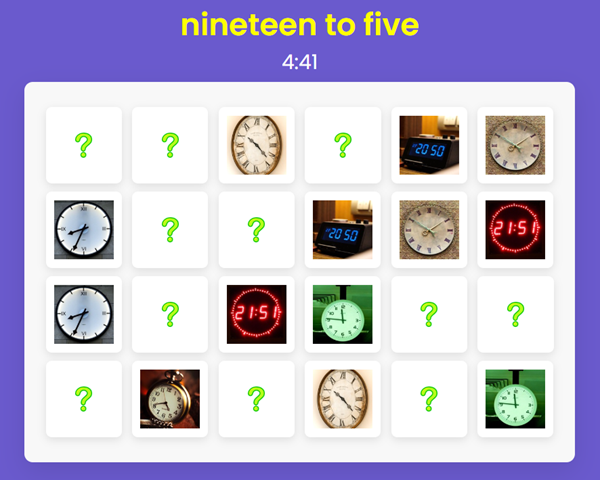
- A free online flashcard matching game (with voice) to help you learn how to tell time in English
- Ένα διασκεδαστικό online παιχνίδι για τους μαθητές της Αγγλικής ηλικίας, παιδιών και ενηλίκων
Ο ήχος (κείμενο σε ομιλία) ενδέχεται να μην αναπαράγεται σωστά εάν η απαιτούμενη φωνή δεν είναι εγκατεστημένη στη συσκευή σας. Για περισσότερες λεπτομέρειες, δείτε Αντιμετώπιση προβλημάτων φωνητικού προβλήματος.


It is…
There are two ways of telling the time in English: the digital way (straight numbers: hour + minutes) and the analogue clock way (using "past / to" + hour).
Here are a few simple tips to help you master time-telling skills in English.
The Simple Way: [Hour] + [Minutes]
Say the hour first, then the minutes.
- 1:12 — It's one twelve.
- 8:28 — It's eight twenty-eight.
- 10:50 — It's ten fifty.
If the minutes are under ten (minutes 01–09), like 10:03, say the zero as "oh":
10:03 — It's ten oh three.
Using "o'clock"
When the time is exactly on the hour ending in :00 minutes (no minutes), e.g. 4:00
- 4:00 — It's four o'clock.
- 11:00 — It's eleven o'clock.
For any time with minutes (e.g. 7:10), don't use "o'clock".
- Incorrect: It's seven ten o'clock. X
- Incorrect: It's seven o'clock ten. X
- Correct: It's seven ten.
- Correct: It's ten past seven.
[Minutes] + past / to + [Hour]
Say the minutes first, then the hour.
Past — for minutes 1 to 30
To — for minutes 31 to 59 (counting how many minutes are left until the next hour)
- 5:17 — seventeen past five
- 5:21 — twenty-one past five
- 5:40 — twenty to six (It's 20 minutes until 6:00)
- 5:52 — eight to six (It's 8 minutes until 6:00)
Half past / quarter past / quarter to
Common expressions for telling the time at 15, 30, and 45 minutes:
It's half past… (X:30) — 30 minutes after the hour
- 4:30 — half past four
- 9:30 — half past nine
It's (a) quarter past… (X:15) — 15 minutes after the hour
- 4:15 — (a) quarter past four
- 9:15 — (a) quarter past nine
It's (a) quarter to… (X:45) — 15 minutes before the next hour
- 4:45 — (a) quarter to five
- 9:45 — (a) quarter to ten
AM vs PM
In English, we rarely use the 24-hour clock (like 14:00 or 21:00) in daily conversation. Instead, we use a 12-hour clock with AM and PM.
AM — morning (midnight to 11:59 a.m.)
PM — afternoon and night (noon to 11:59 p.m.)
e.g. The meeting is at 2:00 p.m. (Not 14:00)
More Examples
| 1:00 |
one o'clock
|
| 2:04 |
four past two
two oh four
|
| 3:15 |
quarter past three
three fifteen
|
| 3:30 |
half past three
three thirty
|
| 4:13 |
thirteen past four
four thirteen
|
| 5:50 |
ten to six
five fifty
|
| 6:45 |
quarter to seven
six forty-five
|
| 7:12 |
twelve past seven
seven twelve
|
| 8:00 |
eight o'clock
|
| 8:41 |
nineteen to nine
eight forty-one
|
| 9:06 |
six past nine
nine oh six
|
| 9:53 |
seven to ten
nine fifty-three
|
| 10:23 |
twenty-three past ten
ten twenty-three
|
| 11:46 |
fourteen to twelve
eleven forty-six
|
| 13:30 |
half past one
one thirty
|
| 14:43 |
seventeen to three
two forty-three
|
| 15:11 |
eleven past three
three eleven
|
| 16:28 |
twenty-eight past four
four twenty-eight
|
| 17:38 |
twenty-two to six
five thirty-eight
|
| 18:16 |
sixteen past six
six sixteen
|
| 20:21 |
twenty-one past eight
eight twenty-one
|
| 20:50 |
ten to nine
eight fifty
|
| 23:34 |
twenty-six to midnight
eleven thirty-four
|
| 23:53 |
seven to midnight
eleven fifty-three
|