
Învață engleza / Jocuri de vocabular și memorie în limba engleză
- A free online flashcard matching game (with voice) to help you learn how to tell time in English
- Un joc online distractiv pentru studenții englezi de toate vârstele, copiii și adulții
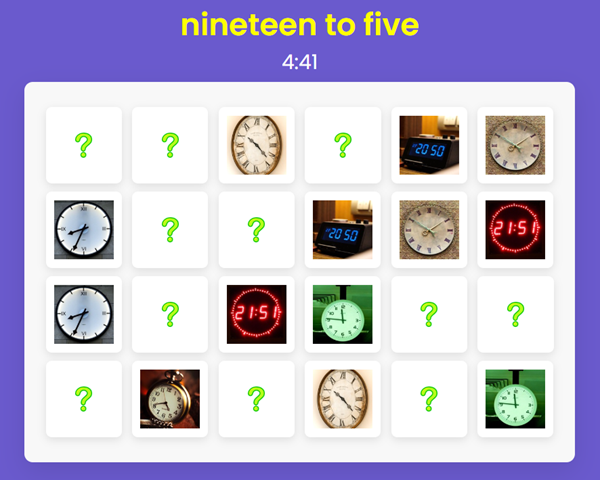
The audio (text-to-speech) may not play correctly if the required voice is not installed on your device. For more details, please see Depanarea problemei cu vocea.


It is…
There are two ways of telling the time in English: the digital way (straight numbers: hour + minutes) and the analogue clock way (using "past / to" + hour).
Here are a few simple tips to help you master time-telling skills in English.
The Simple Way: [Hour] + [Minutes]
Say the hour first, then the minutes.
- 1:12 — It's one twelve.
- 8:28 — It's eight twenty-eight.
- 10:50 — It's ten fifty.
If the minutes are under ten (minutes 01–09), like 10:03, say the zero as "oh":
10:03 — It's ten oh three.
Using "o'clock"
When the time is exactly on the hour ending in :00 minutes (no minutes), e.g. 4:00
- 4:00 — It's four o'clock.
- 11:00 — It's eleven o'clock.
For any time with minutes (e.g. 7:10), don't use "o'clock".
- Incorrect: It's seven ten o'clock. X
- Incorrect: It's seven o'clock ten. X
- Correct: It's seven ten.
- Correct: It's ten past seven.
[Minutes] + past / to + [Hour]
Say the minutes first, then the hour.
Past — for minutes 1 to 30
To — for minutes 31 to 59 (counting how many minutes are left until the next hour)
- 5:17 — seventeen past five
- 5:21 — twenty-one past five
- 5:40 — twenty to six (It's 20 minutes until 6:00)
- 5:52 — eight to six (It's 8 minutes until 6:00)
Half past / quarter past / quarter to
Common expressions for telling the time at 15, 30, and 45 minutes:
It's half past… (X:30) — 30 minutes after the hour
- 4:30 — half past four
- 9:30 — half past nine
It's (a) quarter past… (X:15) — 15 minutes after the hour
- 4:15 — (a) quarter past four
- 9:15 — (a) quarter past nine
It's (a) quarter to… (X:45) — 15 minutes before the next hour
- 4:45 — (a) quarter to five
- 9:45 — (a) quarter to ten
AM vs PM
In English, we rarely use the 24-hour clock (like 14:00 or 21:00) in daily conversation. Instead, we use a 12-hour clock with AM and PM.
AM — morning (midnight to 11:59 a.m.)
PM — afternoon and night (noon to 11:59 p.m.)
e.g. The meeting is at 2:00 p.m. (Not 14:00)
More Examples
| 1:00 |
one o'clock
|
| 2:04 |
four past two
two oh four
|
| 3:15 |
quarter past three
three fifteen
|
| 3:30 |
half past three
three thirty
|
| 4:13 |
thirteen past four
four thirteen
|
| 5:50 |
ten to six
five fifty
|
| 6:45 |
quarter to seven
six forty-five
|
| 7:12 |
twelve past seven
seven twelve
|
| 8:00 |
eight o'clock
|
| 8:41 |
nineteen to nine
eight forty-one
|
| 9:06 |
six past nine
nine oh six
|
| 9:53 |
seven to ten
nine fifty-three
|
| 10:23 |
twenty-three past ten
ten twenty-three
|
| 11:46 |
fourteen to twelve
eleven forty-six
|
| 13:30 |
half past one
one thirty
|
| 14:43 |
seventeen to three
two forty-three
|
| 15:11 |
eleven past three
three eleven
|
| 16:28 |
twenty-eight past four
four twenty-eight
|
| 17:38 |
twenty-two to six
five thirty-eight
|
| 18:16 |
sixteen past six
six sixteen
|
| 20:21 |
twenty-one past eight
eight twenty-one
|
| 20:50 |
ten to nine
eight fifty
|
| 23:34 |
twenty-six to midnight
eleven thirty-four
|
| 23:53 |
seven to midnight
eleven fifty-three
|

![Eveline [Dubliners] by James Joyce (English Audiobook with Full Text)](https://i.ytimg.com/vi/qMJYF-BRBE8/hqdefault.jpg "Eveline [Dubliners] de James Joyce (carte audio în engleză cu text integral)")
